
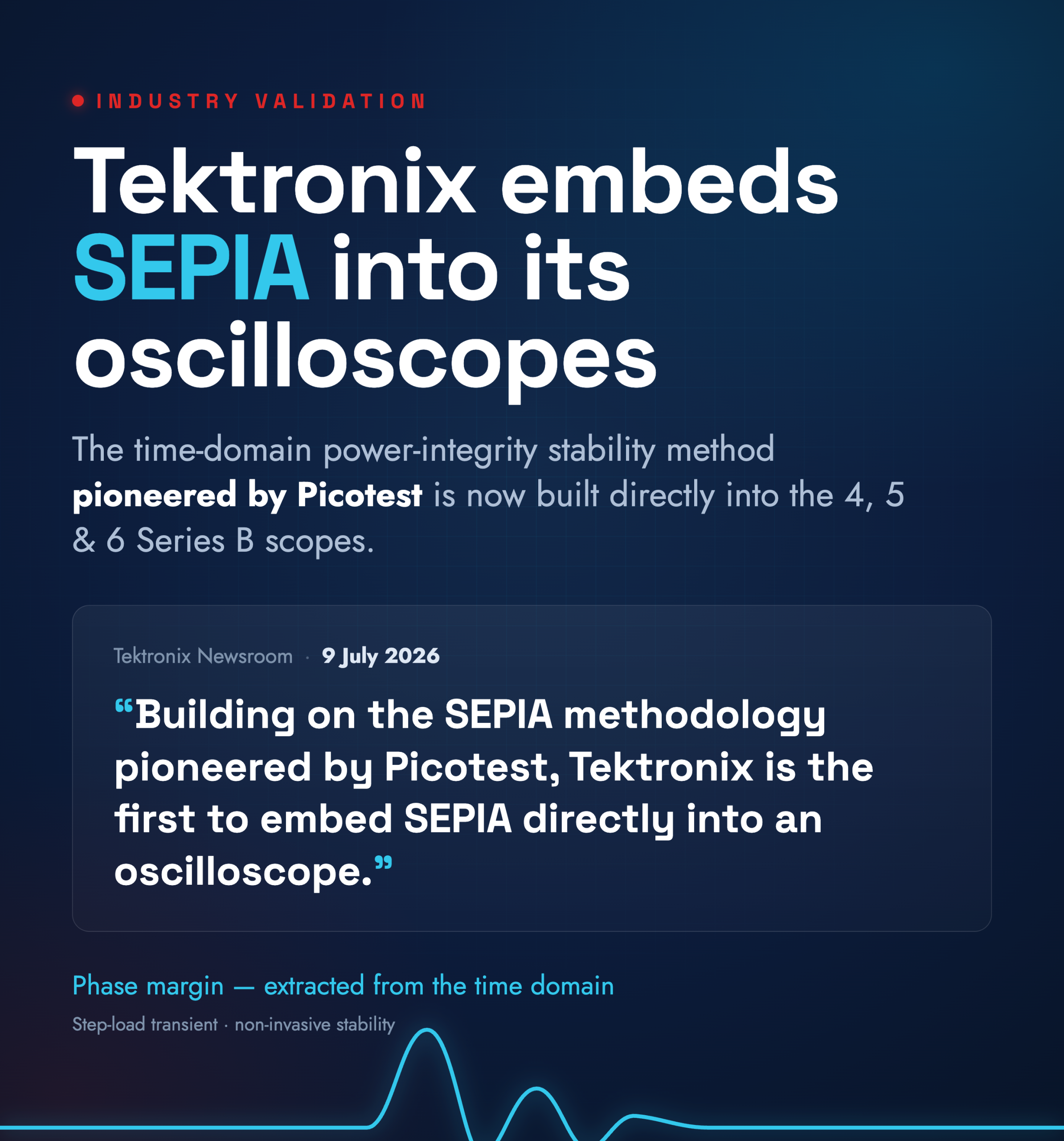
When one of the largest names in test and measurement builds your methodology into its flagship instruments, it says something about where the industry is heading. On July 9, 2026, Tektronix announced new Power Distribution Network (PDN) Analysis Software for its 4, 5, and 6 Series B Mixed Signal Oscilloscopes — and in doing so, it credited Picotest by name.
In Tektronix’s own words: “Building on the Stability Evaluation for Power Integrity Analysis (SEPIA) methodology pioneered by Picotest, Tektronix is the first to embed SEPIA directly into an oscilloscope.”
That single sentence is a milestone for the power-integrity community, and we want to unpack what it actually means for engineers designing today’s most demanding power distribution networks.
What Tektronix announced
The new PDN Analysis Software unifies power integrity and signal integrity validation into a single oscilloscope workflow. Tektronix positions it squarely at the hardest problems in the industry right now: AI servers, high-performance computing, and advanced automotive electronics — all applications where power rails are getting lower in voltage, higher in current, and far less forgiving of instability.
According to the announcement, the software delivers:
- Large-signal transient stability analysis, extracting phase margin and damping characteristics from real operating conditions rather than idealized small-signal models.
- 2-port shunt-through impedance profiling from 10 Hz to 50 MHz — the reference technique for measuring the ultra-low impedances found in modern PDNs.
- Power-supply-induced jitter correlation with high-speed serial waveforms, connecting a noisy rail to the signal-integrity problems it causes downstream.
- Power Supply Rejection Ratio (PSRR) metrics to 85 dB.
Daryl Ellis, VP and General Manager at Tektronix, framed the value simply: “By bringing time-domain stability analysis into the oscilloscope, engineers can evaluate power distribution network behavior under real operating conditions.”
That phrase — time-domain stability analysis — is the heart of it, and it’s exactly what SEPIA was created to do.
So what is SEPIA?
SEPIA stands for Stability Evaluation for Power Integrity Analysis. It’s a method for extracting the stability of a power supply’s control loop — most importantly its phase margin — directly from a time-domain waveform, such as the response to a step load.
Traditionally, measuring loop stability meant breaking the loop: injecting a signal into the feedback path with an injection transformer and sweeping frequency to produce a Bode plot. That works, but it requires access to the feedback node, which is increasingly buried, inaccessible, or simply nonexistent on tightly integrated modern regulators and point-of-load converters.
SEPIA takes a different route. By analyzing the shape of the transient response — the ringing, overshoot, and damping that appear when a converter reacts to a sudden change in load — it recovers the underlying loop characteristics without breaking the loop. It is closely related to Picotest’s Non-Invasive Stability Margin (NISM) work, which established that the stability information you need is already present in measurements you can take from the outside.
For engineers, the practical payoff is significant: you can assess whether a rail is comfortably stable or dangerously close to the edge using a waveform you can actually capture on real hardware, under real conditions, without a test point that may not exist.
Why the industry is moving this way
Two forces are converging. First, PDNs are harder than ever. AI accelerators and high-density compute draw enormous, fast-changing currents at sub-1-volt rails where a few milliohms of impedance or a few degrees of lost phase margin can mean the difference between a robust product and an intermittent field failure. Second, engineers need answers faster and with fewer specialized setups.
Embedding a time-domain stability method directly into a mainstream oscilloscope — the instrument already on every power engineer’s bench — lowers the barrier to doing this analysis at all. It moves stability evaluation from a specialist activity into everyday validation. That’s good for the whole field, and it validates an approach Picotest has advocated for years: that the most useful power-integrity measurements are the ones you can make non-invasively, on the real system.
Picotest’s role — and where the measurement chain still lives
Methods are only as good as the measurements feeding them, and this is where Picotest’s tools come in. The techniques Tektronix references — time-domain stability analysis and 2-port shunt-through impedance profiling — depend on a clean, well-controlled measurement chain:
- 2-port shunt-through impedance measurements down to the sub-milliohm range rely on purpose-built probes such as the Picotest P2102A 2-Port Probe, designed specifically for VRM, power-plane, and decoupling impedance work.
- PSRR and line-injection measurements use dedicated injectors from the Picotest signal-injector family.
- Ultra-low-noise rail measurements benefit from low-noise preamplification to pull small signals out of the noise floor.
In other words: the industry is now embedding the analysis, but the quality of the data still comes from getting the front-end measurement right. That’s the part Picotest has spent its history solving.
The takeaway
Tektronix embedding SEPIA into its oscilloscopes is a strong signal that time-domain, non-invasive stability analysis has arrived as mainstream best practice — not a niche technique. For power-integrity engineers, it means the methods Picotest pioneered are now easier to reach than ever. And it’s a reminder that behind every good stability number is a good measurement.
If you’re building the PDN validation setup behind these techniques — the probes, injectors, and low-noise front end that make time-domain stability and 2-port impedance measurements trustworthy — that’s exactly what Picotest builds. Explore Picotest’s power-integrity measurement tools →
Sources
Picotest, “Ultra-low Impedance Testing Using the 2-Port Shunt-Through Measurement Technique”
Tektronix press release, “Tektronix Unifies Power and Signal Integrity Analysis for Modern Power Distribution Networks,” July 9, 2026 — tek.com
Picotest, “Loop Analysis Directly from Time-Domain Waveform with SEPIA” — picotest.com
Picotest, “P2102A 2-Port Probe” — picotest.com
Related Products
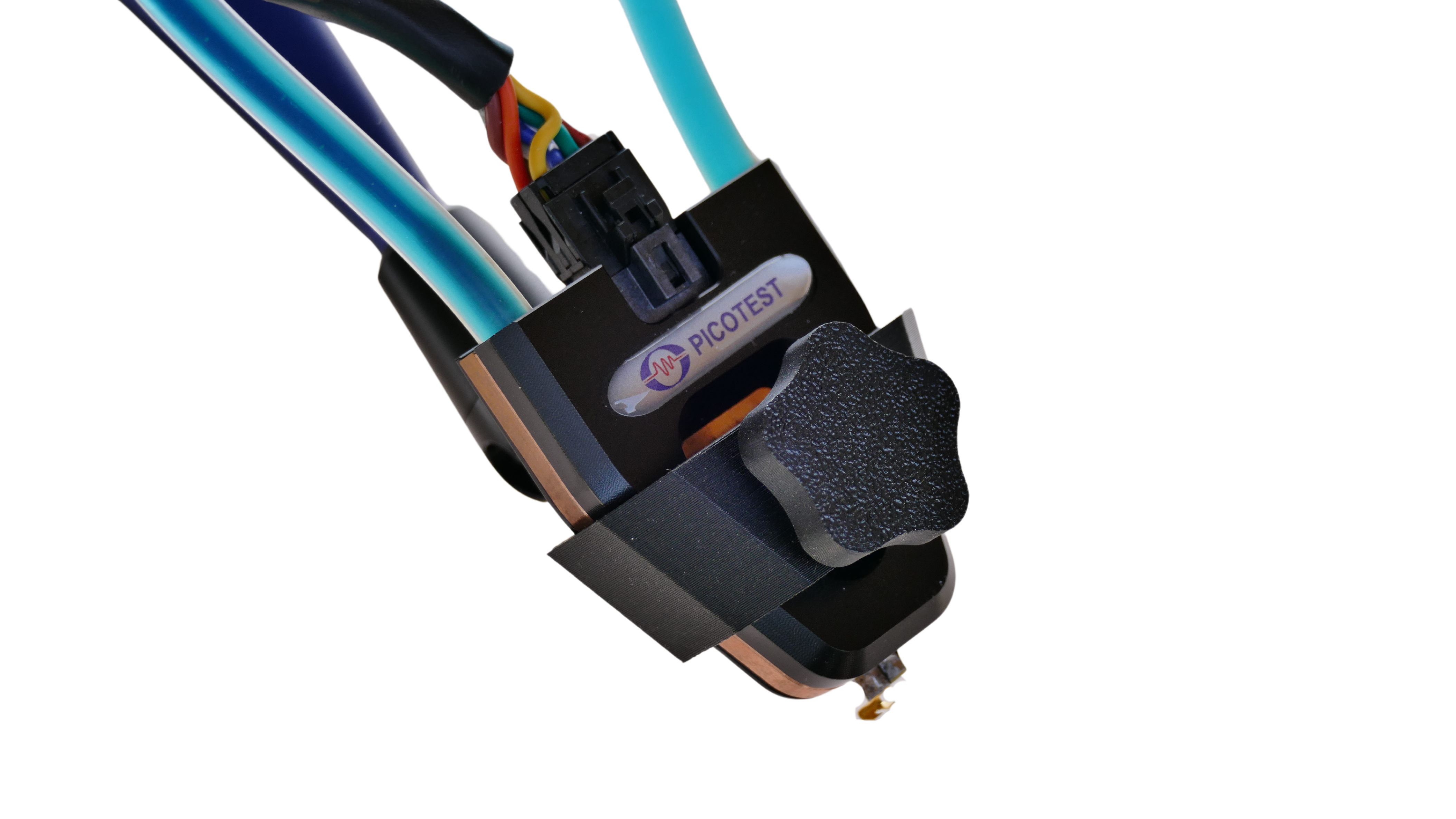

P2105A (S10 Version) for Transient Load Step Testing
Read more: P2105A (S10 Version) for Transient Load Step Testing